The numbers, honestly
RevenueCat’s State of Subscription Apps 2026, published in March 2026, compares apps whose primary value comes from AI with everything else. The headline: AI apps earn about 41% more revenue per paying user, and lose those users about 30% faster.
| Plan length | AI apps | Non-AI apps |
|---|---|---|
| Weekly | 2.5% | 1.7% |
| Monthly | 6.1% | 9.5% |
| Annual | 21.1% | 30.7% |
Share of subscribers still retained 12 months after their first payment, by plan length. Source: RevenueCat, State of Subscription Apps 2026.
Two things the table does not say. It is not a curve — each row is a different plan length measured at the same 12-month mark, so you cannot read a “cliff” off it. And it is a median across thousands of apps; a single app can sit anywhere.
What it does say is enough: at the median, an AI subscription is a hard thing to keep. Kajo sidesteps the renewal problem by not having a renewal — it is one $49 purchase; you start free, and pay once to unlock unlimited imports and Lifetime convenience (watch folders, batch export), local-only. But a one-time price does not make activation optional. With no recurring revenue to lean on, we only earn the purchase if a free user reaches genuine value first. Below is what we actually do — not what we would like to do.
Why AI apps churn faster — the root causes
1. Activation failure in the first week
Most AI apps are installed with optimistic intent (“I’ll use this for my interviews”) but no first-moment anchor. Without a specific workflow that creates obvious value on day one, the app becomes a monthly guilt item. The user cancels before finding the value.
2. Cloud friction keeps the app out of the work that matters
Cloud transcription means uploading audio to a vendor. That is a hard blocker in exactly the cases where the tool would be most valuable: a journalist protecting a source, a lawyer with a privileged recording, a researcher under an IRB protocol. The friction surfaces when the use case matters most — and people opt out permanently.
3. Single-use-case apps hit a ceiling
An app that does one thing well is sticky until you have done that one thing. After a month of transcribing files, a user may feel they have “solved” the problem. Apps that do not deepen into adjacent jobs lose the marginal user.
4. No compounding value — no lock-in
The strongest retention mechanism is a personal knowledge base that grows more valuable with every session. Without it, each session is worth the same as the first. There is no switching cost and no forward incentive.
What Kajo does about each of these
Activation failure → a first-week cited answer. Our leading activation indicator is a cited chat answer within 7 days of the first import. The app is built to get you there without a tutorial: a new chat opens scoped to the folder you are standing in, and the starter jobs — Themes, Find the quote, Brief me — run against it with one click.
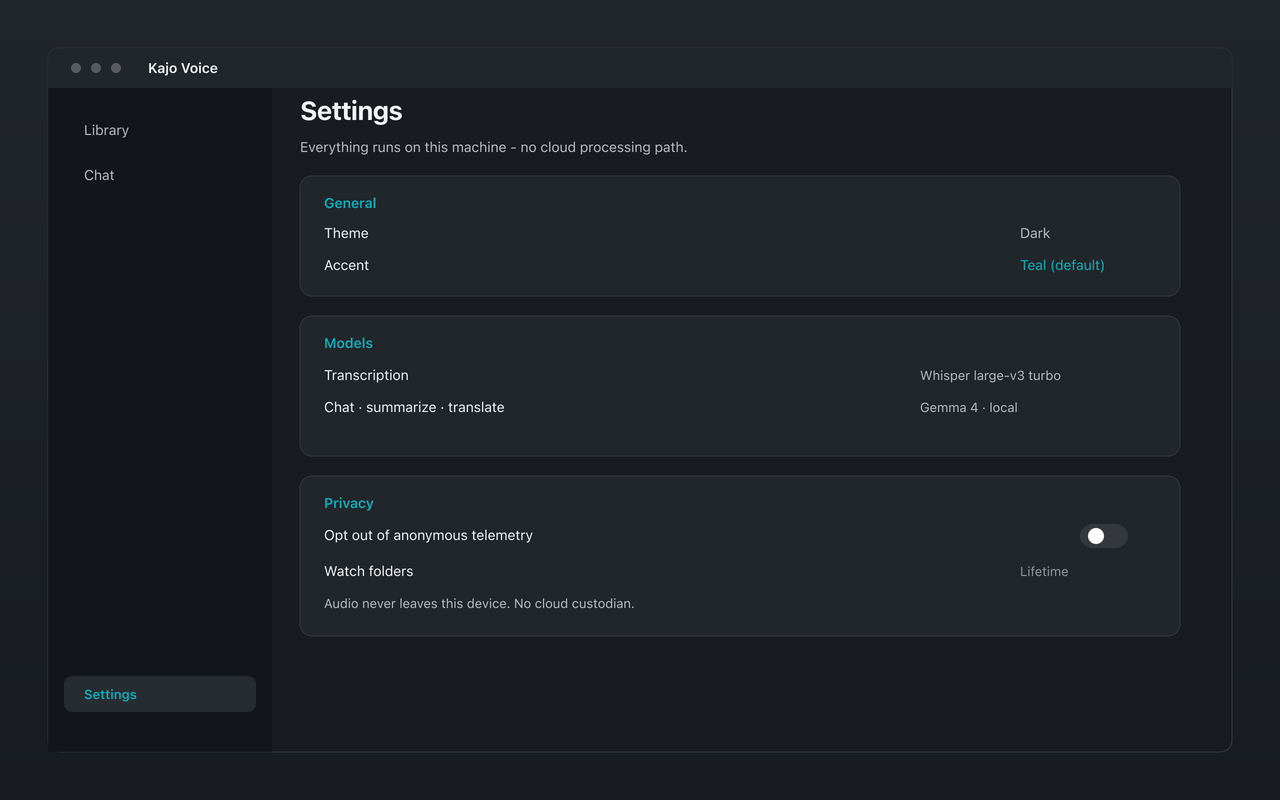
Cloud friction → on-device by construction. Transcription, translation, summaries, and chat run on your machine. No audio or transcript is ever sent to Kajo servers, because there is no cloud-processing path. That removes the blocker for legal, journalistic, research, and confidential work.
The single-use ceiling → one library, many jobs. Every recording you import — dropped in, picked from a folder, or, on Lifetime, collected by a watch folder — lands in the same searchable library. Transcripts, speaker labels, translations, summaries, cited chat, and exports to CAQDAS tools all work off that one archive, so the second job is already set up when the first is done.
No compounding value → the library is the retention engine. The index covers every transcript you import. Its value compounds: a hundred recordings are worth more than ten, and five hundred more than a hundred. The library lives on your machine — per-file export is always available, and Lifetime adds batch export. The switching cost grows with time, not because the data is locked in, but because the archive becomes genuinely irreplaceable.
The honest constraint
These are our targets and mechanisms — not results. Kajo is pre-launch as of this writing. We do not have cohort data, and we can only ever measure people who opt in to analytics. The RevenueCat figures are the category baseline; whether Kajo beats them depends on whether the mechanisms above work in practice.
What we can commit to: we will publish retention data once we have it. If we are beating the 12-month monthly-plan baseline of 6.1%, we will say so with the numbers. If we are not, we will say that too and explain what changed.
Our answer to churn is structural: there is no subscription to cancel. Kajo is a single $49 one-time purchase — a user who paid once has no monthly cancellation moment. That also raises the bar before the sale: with no recurring revenue to lean on, we only earn the purchase if a free user reaches genuine value first. One payment unlocks unlimited imports and Lifetime convenience (watch folders, batch export); folders and the core loop are already on Free within the allowance; privacy is by architecture; your installed version keeps working forever. The product has to be worth owning, not just worth renting.
Related
Library explained → Lifetime Local-Only explained → All plans →