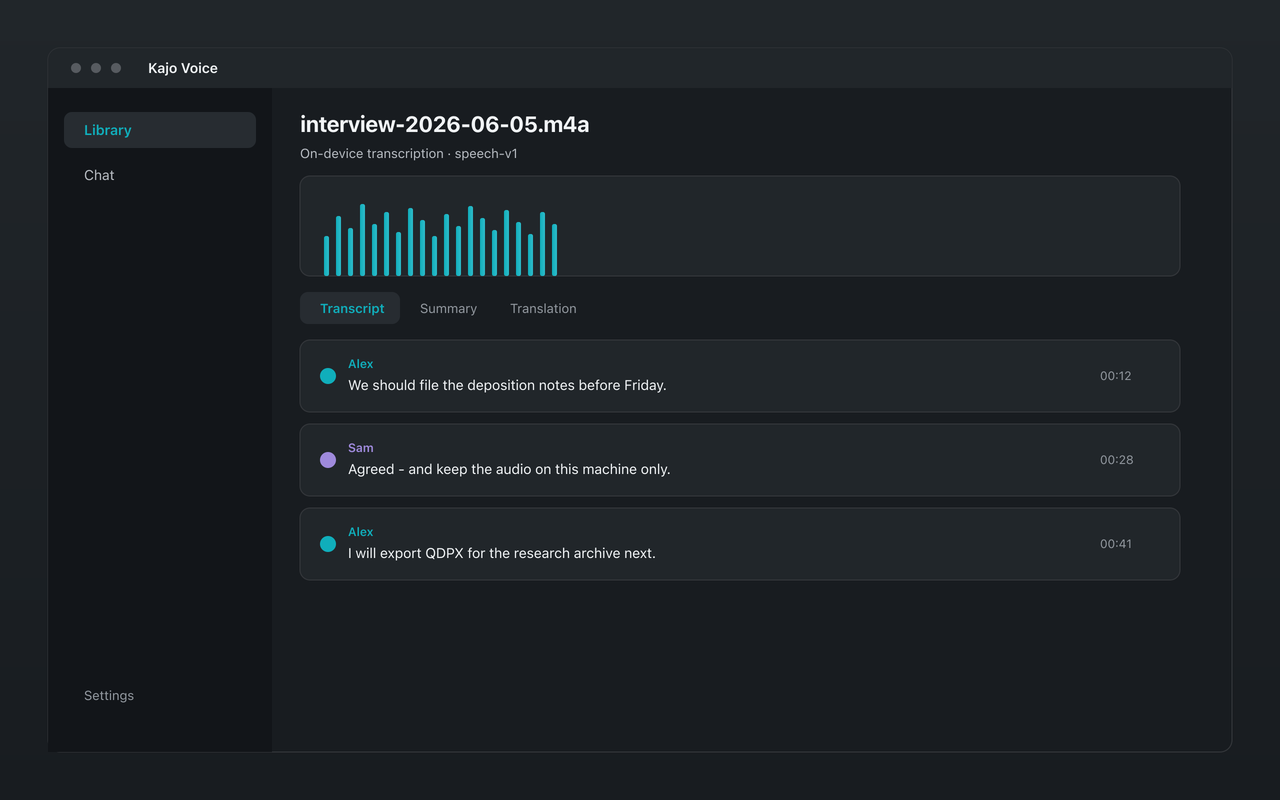
Spanish-English bilingualism is one of the most common forms of multilingualism in the world. In the United States alone, tens of millions of people move between the two languages in daily life, often within the same sentence. The resulting speech — Spanglish, code-switching, or simply bilingual conversation — is natural and communicatively rich. It is also hard on speech recognition systems that expect a speaker to stay in one language.
Kajo Voice transcribes that conversation as it was spoken, on your machine, files it into a private library, and lets you ask questions across a whole folder of interviews in either language — with every answer cited back to the moment in the recording.
The Spanish-English code-switching reality
Code-switching between Spanish and English is not random. Bilingual speakers follow consistent, often unconscious patterns:
- Switching for domain-specific terms that feel more natural in one language (technical terms often English, emotional expressions often Spanish)
- Switching to soften or emphasize a point
- Switching to signal identity or community membership
- Switching because a concept or phrase simply does not translate comfortably
A consultant’s Spanish-speaking client might say: “Me siento muy overwhelmed lately, you know what I mean? Es que everything is too much — el trabajo, la familia, todo.” A journalist’s source might say: “La investigación shows que the impact fue más grande de lo esperado.”
In each case the meaning is clear to a bilingual listener and the switch is purposeful. A transcription system that cannot handle it produces garbage: either the Spanish portions become unrecognizable, the English portions are transcribed as Spanish phonetics, or the system gives up on the switched segments entirely.
How Kajo handles it — honestly
Kajo’s engine decides a recording’s language once, from its opening, then decodes with a vocabulary that spans all 98 languages it knows. In practice:
- Short switches — a borrowed phrase, a name, a technical term — usually come through as spoken, because nothing forces them through a single-language dictionary.
- Long runs in the second language can be pulled toward the detected one. Those are the spans to review.
- If one language dominates, set it in Settings → Transcription so a short opening in the other language cannot mislabel the whole file. Leave detection automatic only when the two are roughly balanced.
That is the model’s own behaviour inside a desktop app. There is no separate “code-switching product layer,” and we do not publish an accuracy percentage for it — the developer of the model publishes per-language error rates, linked from the engine guide, and the free allowance lets you test your own recordings before you pay.
Who this is for
Researchers of bilingual communities. Linguists studying Spanglish, sociolinguists documenting code-switching, and oral historians recording diaspora families produce audio that is inherently bilingual. The transcript keeps the switch — which is often the finding — and the source-language text stays as the audit trail.
Lawyers and consultants with bilingual clients. The language a client shifts to during a sensitive moment can carry real meaning. Transcribing the mix as spoken captures it, and local processing keeps confidential client recordings off any cloud service. Depositions involving bilingual parties produce mixed-language audio too — note that Kajo is not a certified transcript.
Journalists covering Latin America and the Latinx diaspora. Reporters interviewing bilingual sources need a record of what was actually said, not an English-only approximation that loses the speaker’s voice — and a source’s recording should never sit on a vendor’s server.
The bilingual archive loop
- Import the interview (MP3, WAV, M4A, MP4 and more — or a whole folder).
- Kajo transcribes on your machine and labels the speakers automatically; rename them once.
- Translate on-device into a working language for a monolingual colleague — the original transcript is kept alongside.
- File the recording into the study or story folder.
- Pin that folder in chat and ask in either language — “¿Qué dijeron sobre el trabajo?” or “What did they say about work?” — and land on the exact moment, with a citation.
Documentary makers can export bilingual SRT/VTT — each original line paired with its on-device translation — for a cut that serves both audiences.
FAQ
Can Kajo separate the Spanish and English portions of the transcript? Kajo produces a mixed-language transcript that reflects the speech as delivered. To read it in one language, use on-device Gemma 4 translation for a full working copy; the original stays as the source of record.
Does Kajo work for Portuguese-English code-switching as well? Portuguese is in the same 98-language catalogue and follows the same path: one language decision per recording, a multilingual vocabulary, and review at the switch points.
What about formal Spanish without code-switching? Set Spanish as the language in Settings → Transcription and Kajo transcribes monolingual Spanish on-device, with no code-switching complexity.
Pricing
- Free — 5 files or 150 minutes of audio (total, for life) to test code-switching on your own recordings
- Lifetime — one payment ($49 launch / $99 standard) unlocks unlimited imports and Lifetime convenience (watch folders, batch export); your installed version keeps working forever