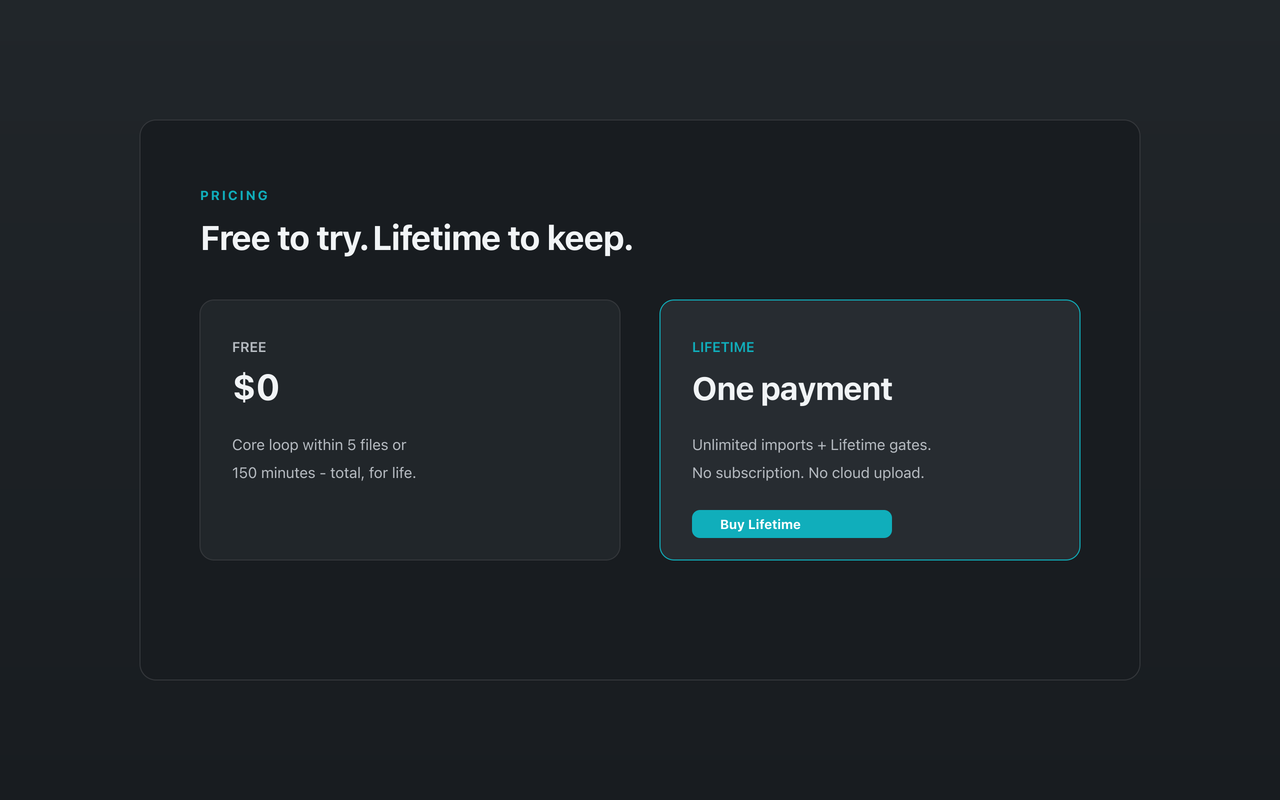
Transcription pricing looks cheap in the monthly column and expensive in the five-year column. Subscriptions meter seats and minutes; your archive’s usefulness quietly depends on keeping the card on file. A one-time lifetime purchase flips the model: pay once for unlimited on-device use, and your installed version keeps working forever.
This article compares the economics and the product assumptions behind subscription cloud transcription versus Kajo Voice’s free-then-lifetime local model — without inventing fake Kajo monthly prices (there are none).
Two different products pretending to be the same SKU
Subscription cloud transcription usually sells convenience: upload or bot-capture, hosted transcription, hosted notes, team workspaces. The meter funds GPUs, storage, and go-to-market. Your marginal cost to the vendor is not zero, so plans reset, cap, or upsell.
Local one-time transcription sells software that runs on hardware you already own. After models are on disk, each additional hour costs electricity and time, not a vendor invoice. The vendor’s ongoing cost is support and desktop releases — not per-minute inference on your interviews.
If you need a live meeting bot and shared cloud workspaces, subscriptions may still fit. If you need a private archive you will reopen for years, one-time local math usually wins.
A simple five-year sketch
Take a real subscription: Otter Pro lists at $16.99/user/month billed monthly ($8.33/user/month billed annually). On monthly billing, one seat costs:
- Year 1: about $204
- Year 3: about $612
- Year 5: about $1,020
Annual billing roughly halves the sketch but not the conclusion. Kajo Lifetime is $49 launch / $99 standard — once. Add per-minute overages, extra seats, or “AI credit” packs on the subscription side and the gap widens. On the Kajo side, Free already includes the core loop up to 5 files or 150 minutes total — enough to validate accuracy and privacy before you pay.
Lifetime is $49 — a single one-time purchase, not a discounted first invoice on a recurring plan.
What you are actually renting
Subscriptions often bundle:
- Hosted storage of audio and transcripts
- Hosted model improvements you only get while subscribed
- Collaboration features that assume vendor accounts
- Soft lock-in: export is possible, but daily search lives in their UI
When you cancel, you may keep exports, but the living knowledge base — search, AI Q&A, bot integrations — typically degrades. The archive becomes a pile of DOCX files again.
A local lifetime licence bundles different assumptions:
- Inference on your machine (one on-device engine for transcription; Gemma 4 for translate, summarize, and chat)
- A private library that remains queryable offline
- Exports (including QDPX) whenever you need them
- No Kajo monthly price, because billing is not the product
Forever, in Kajo’s wording, means your installed version keeps working forever — not a promise that a SaaS tenant will host your data indefinitely.
Hidden subscription costs beyond the sticker
Privacy process cost. Legal review, DPAs, IRB amendments, and “can we use this vendor?” threads are real hours. Local-only transcription removes the speech subprocessor from many of those reviews.
Rationing behavior. Minute caps teach people not to transcribe everything. Researchers sample; journalists skip “less important” tapes. One-time unlimited imports make complete archives rational.
Tool sprawl. A cheap subscription that only does mediocre text still leaves you paying for a separate translator and a notes app. Kajo’s loop is intentionally one product: transcribe · translate · summarize · library · cited chat.
Platform gaps. If your daily driver is Linux, many subscription voice apps simply do not exist as first-class desktop citizens. Local Linux builds change the make-vs-rent calculus again.
When subscriptions still win
Be fair:
- You need bots to join meetings automatically every day
- The content is low sensitivity and convenience dominates
- Procurement prefers OpEx subscriptions to a one-time tool purchase
- You truly use the tool lightly and will cancel within months
In those cases, paying monthly for a cloud suite can be rational. Kajo is not trying to be that suite.
When one-time local wins
- Client, session, legal, or human-subjects audio must not upload
- You transcribe weekly and expect to for years
- You want cited chat over a corpus you control
- You are building a longitudinal interview archive (library folders, plus watch folders on Lifetime)
- You are done renting access to your own notes
How to decide in one afternoon
- Pick three real files you care about (including one sensitive file)
- Run them through a cloud trial you already distrust — note the upload
- Run them through Kajo’s free tier — note the local path
- Price your actual cloud habit for 36 months (seats × months + overages)
- Compare to $49 launch / $99 standard one-time
If step 4 is already larger than step 5, and step 2 makes your stomach tight, the architecture decision is finished.
Product truth checklist (so the math matches reality)
- Transcription: one on-device engine — Transcribes 98 languages on your laptop — all on-device.
- Translate / summarize / chat: on-device Gemma 4
- Free: 5 files or 150 minutes, cumulative for life
- Paid: one payment ($49 launch / $99 standard) unlocks unlimited imports and Lifetime convenience (watch folders, batch export) — not a Kajo subscription tier
- Intake automation: watch folders on disk (Lifetime)
- Research export: QDPX among other formats
Bottom line
Subscriptions sell continuous access to someone else’s GPUs and workspace. A one-time local licence sells a durable tool for an archive you intend to own. If your work product is the library — not the meeting bot — pay once, keep the machine under your policy, and stop metering your own memory.