Most people who use AI transcription tools have not thought carefully about what happens to their audio. They record a conversation, click “transcribe,” and get back text. Where the audio went, who had access to it, and how long it is retained are questions that rarely surface until something goes wrong.
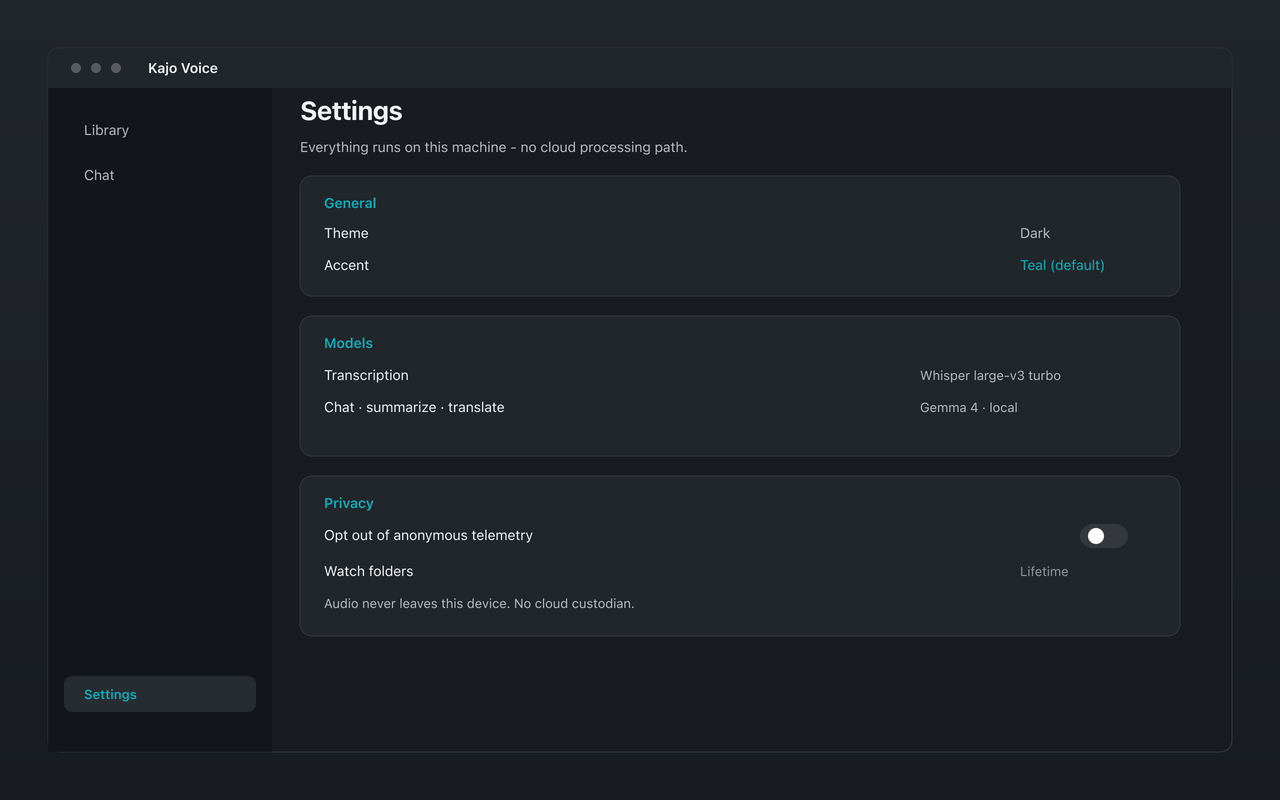
This guide explains what different transcription architectures mean for privacy, who should care most, and what questions to ask before choosing a transcription tool — including what Kajo Voice itself sends, so you can hold it to the same standard.
What cloud transcription services do with your audio
When you upload audio to a cloud transcription service — or when a meeting bot records your calls — several things happen that are easy to miss in the terms of service:
Transmission
Your audio is transmitted to the service’s servers, typically over encrypted HTTPS. Transmission encryption protects the audio in transit from your device to their servers, but not from what happens after it arrives.
Storage
Most cloud transcription services retain your audio for some period after transcription. Retention policies vary:
- Some services retain audio indefinitely unless you explicitly delete it
- Some automatically delete after 30, 90, or 365 days
- Some retain transcripts much longer than audio
- Some retain usage data and metadata even after audio deletion
Review your service’s data retention policy specifically — the marketing copy about “security” often does not disclose retention details.
Processing
Your audio is processed by the service’s AI infrastructure. For major services, this typically means GPU clusters running speech models. Some services also use human review — quality assurance contractors who listen to audio samples to evaluate model accuracy. Rev’s human transcription service has human transcribers listen to your complete recordings.
Data use
Some services use your content to improve their models. This means your audio or transcripts may be used as training data for future AI models. Most services offer opt-out mechanisms in their settings — but the default often has it switched on. Otter, for example, states in its privacy policy that it Trains its own AI on de-identified recordings and transcripts; the policy lists no opt-out.
Review your service’s “data for improving our services” settings. If you handle sensitive content, opt out — where you can.
Breach exposure
Your audio lives on the service’s servers. If those servers are breached, your audio is exposed. Cloud services do have security teams and practices — but no service has a perfect security record, and data breaches expose historical data that was already stored.
Regulatory frameworks and transcription
Confidential and regulated recordings
Many recordings carry confidential or regulated data — a privileged client call, a deposition, a participant interview under an IRB protocol, a sensitive business debrief.
Cloud transcription: Your recording is uploaded to a vendor’s servers, where a third party now holds the most sensitive form of the data. You typically need a contract governing how the vendor processes it, and you inherit the vendor’s breach exposure.
Local transcription: If transcription runs on your device, there is no third-party processor for the transcription step at all. The recording stays on your device. Kajo runs every stage — transcription, translation, summaries, and chat — on-device, so there is no cloud path for your recordings.
GDPR (European personal data)
GDPR requires a legal basis for processing personal data and appropriate safeguards for transfers to third countries. A voice recording of an identifiable person is personal data.
Cloud transcription under GDPR: You typically need a Data Processing Agreement with the cloud provider. Transfer outside the EU/EEA (to US-based cloud services) requires additional safeguards (Standard Contractual Clauses, an adequacy decision, or similar). This analysis is non-trivial.
Local transcription under GDPR: If processing happens on your device and stays there, the GDPR compliance analysis is simpler — the data controller (you) is processing it on your own infrastructure. No DPA with a cloud vendor is needed for that step.
Attorney-client privilege (Legal)
Communications between attorney and client are privileged — protected from disclosure in legal proceedings. Voluntary disclosure to a third party can waive privilege.
The legal question of whether uploading to a transcription service waives privilege is unsettled. Many attorneys take a conservative position: do not upload privileged recordings to any cloud service. Local transcription is architecturally safer — there is no third party and therefore no disclosure.
IRB protocols (Academic research)
Institutional Review Boards require that research participant data be handled with appropriate safeguards. Most IRB protocols require that recordings be kept within the research team.
Uploading recordings to a cloud transcription service may violate your IRB protocol — the service is outside the research team. IRBs are increasingly aware of this issue and some have begun requiring explicit disclosure of transcription service use in protocols.
Local transcription (Kajo on your research machine) keeps recordings within the research environment.
Questions to ask any transcription service
Before using a cloud transcription service with sensitive content, ask:
- Is my audio retained after transcription? For how long?
- Do human employees or contractors ever listen to my audio?
- Is my audio used to train AI models? Can I opt out?
- Can you provide a signed attestation of how my recordings are handled?
- Do you offer a GDPR Data Processing Agreement?
- Where are your servers located? What country?
- What happens to my audio if I cancel my account?
- Have you had any security incidents involving customer audio?
Most services have answers to these questions — usually in their privacy policy and terms of service — but the answers are often buried or require careful reading to understand.
What Kajo itself sends — the same questions, answered
- Audio and transcripts: never. Transcription, speaker labels, translation, summaries, and chat run on your machine; there is no cloud-processing path to enable.
- Licence validation: the app checks its licence against Kajo’s backend when it is online. That request carries a licence key and an install id, not content.
- Crash reports: sent to Sentry unless you opt out in Settings → Privacy; stack traces and device metadata, never audio or transcript text.
- Product analytics: opt-in only (PostHog, EU region); event counts, never content.
- Subprocessors: published in full at /legal/subprocessors — Paddle, AWS, Cloudflare, Hugging Face, Plausible, PostHog, Resend, Sentry.
- DPA: the template is public at /legal/dpa and executed on request after a Lifetime purchase.
- Certifications: none claimed. The posture is published architecture and legal documents, which you can verify yourself by watching the network while a file transcribes.
- Deletion: deleting a recording inside Kajo removes the app’s audio copy, the transcript, the search index, and the chats that only used that recording; the original file on your disk stays.
The architecture that eliminates most of these questions
Local transcription sidesteps most of these questions by design. If audio never leaves your device:
- The retention policy is your own (you control when it is deleted)
- Human access requires physical access to your device
- Training-data use is impossible without your data
- Compliance analysis focuses on device-level security, not vendor compliance
- GDPR analysis is simpler — no cross-border transfer
- There is no third-party custodian to anchor a privilege-waiver argument
This does not mean local transcription has no security considerations — your device can be lost, stolen, or accessed by others. Device-level security (encryption at rest, strong passwords, screen lock) is still required. But the threat model is your device security, not a cloud vendor’s security posture.
Practical recommendations by user type
Legal professionals: Use local transcription for client-related audio. Seek explicit legal guidance on your jurisdiction’s treatment of cloud services and privilege.
Researchers: Check your IRB protocol. Use local transcription to stay clearly within the research team boundary.
Journalists: Use local transcription for sensitive sources. The architectural protection aligns with journalistic source protection obligations.
Consultants: Client NDAs rarely contemplate a third-party transcription vendor. Local transcription keeps the engagement’s recordings inside the boundary the NDA already draws.
Session-based practitioners: Review before anything leaves this machine. Local transcription keeps a client’s words on the device they were recorded on, under your professional obligations.
Business users with non-sensitive content: Cloud services are likely fine. Review retention and training-data policies; opt out of training-data use.