Arabic transcription presents challenges that don’t exist in most other language contexts. The gap between written Modern Standard Arabic (MSA) and spoken dialects is enormous — an Egyptian Arabic speaker and a Moroccan Arabic speaker may have difficulty understanding each other, yet both produce “Arabic audio.” Code-switching between Arabic dialects and European languages (primarily English and French) is pervasive in many professional and research contexts.
Most transcription tools handle Arabic as a single language. Kajo’s on-device engine was trained on a large multilingual corpus that includes Arabic and handles the dialect landscape reasonably well. Independent Arabic benchmarks (the Open Universal Arabic ASR Leaderboard, arXiv:2412.13788, Table 1) show that the model Kajo runs still misses roughly a third of words on dialect-heavy speech — about 33% word error rate, against about 30% for its larger sibling. That is good enough for search and a first pass, not for a verbatim record. For high-stakes Arabic — legal proceedings, hard dialects, code-switching — plan on human review. Engine details are in the engine guide.
The Arabic dialect challenge
Arabic exists along a complex diglossia spectrum:
Modern Standard Arabic (MSA / الفصحى): The formal written standard. Used in news broadcasts, formal speeches, academic lectures, and written communication. High literacy and recognition across the Arab world. Most ASR systems, Kajo’s engine included, perform well on MSA.
Egyptian Arabic (عامية مصرية): The most widely understood Arabic dialect due to Egypt’s dominant media presence (film, television, music). Spoken by roughly 100 million people.
Gulf Arabic (خليجي): Includes Saudi, Emirati, Kuwaiti, Qatari, Bahraini, and Omani variants. Used in business contexts across the GCC. Substantial vocabulary differences from Egyptian.
Levantine Arabic (شامي): Syrian, Lebanese, Jordanian, and Palestinian dialects. Distinctive phonology (e.g., القاف rendered as a glottal stop or /k/ rather than /q/).
Moroccan Darija (دارجة): Heavily influenced by French and Berber. Often unintelligible to Eastern Arabic speakers. Significant code-switching with French is the norm.
Iraqi Arabic: Distinct dialect with its own phonological and vocabulary features.
ASR models trained primarily on MSA — and many cloud services are — will produce poor transcription on dialectal Arabic, particularly Moroccan and Gulf dialects. The text output may be MSA “corrections” of dialectal speech that miss the actual words spoken.
Arabic performance: what to expect
Expect MSA and Egyptian to transcribe best, Levantine next, Gulf and Iraqi more variably, and Moroccan Darija to need the most review — the order mirrors how much of each variety exists in public speech corpora. Treat every dialect transcript as a first pass, and measure on your own tape: the free allowance covers a representative clip.
Arabic-English and Arabic-French code-switching
Code-switching is pervasive in many Arabic professional contexts:
- Gulf business: Professionals often switch between Gulf Arabic and English in technical discussions
- Lebanese and Moroccan: Regular code-switching between Arabic and French
- Academic: MSA/English code-switching in scientific and technical discussions
- Diaspora communities: Heritage speakers who mix Arabic with the language of their country of residence
Standard ASR models struggle at code-switch points — the model is set to one language and produces errors when the other appears. Kajo’s engine decides the recording’s language once, from its opening, and decodes with a vocabulary that spans all 98 languages — so short borrowed phrases usually come through as spoken, while long stretches in the other language can be pulled toward the detected one. For heavily mixed tape, set the dominant language in Settings → Transcription and review the switch points.
For a Lebanese executive who says “We need to review the العقد وإذا فيه أي مشكلة we should involve legal”, the transcript should keep both the Arabic segment (“العقد وإذا فيه أي مشكلة”) and the English segments (“We need to review the” and “we should involve legal”) in sequence — check those switch points.
The Arabic loop: transcribe, label, translate, ask
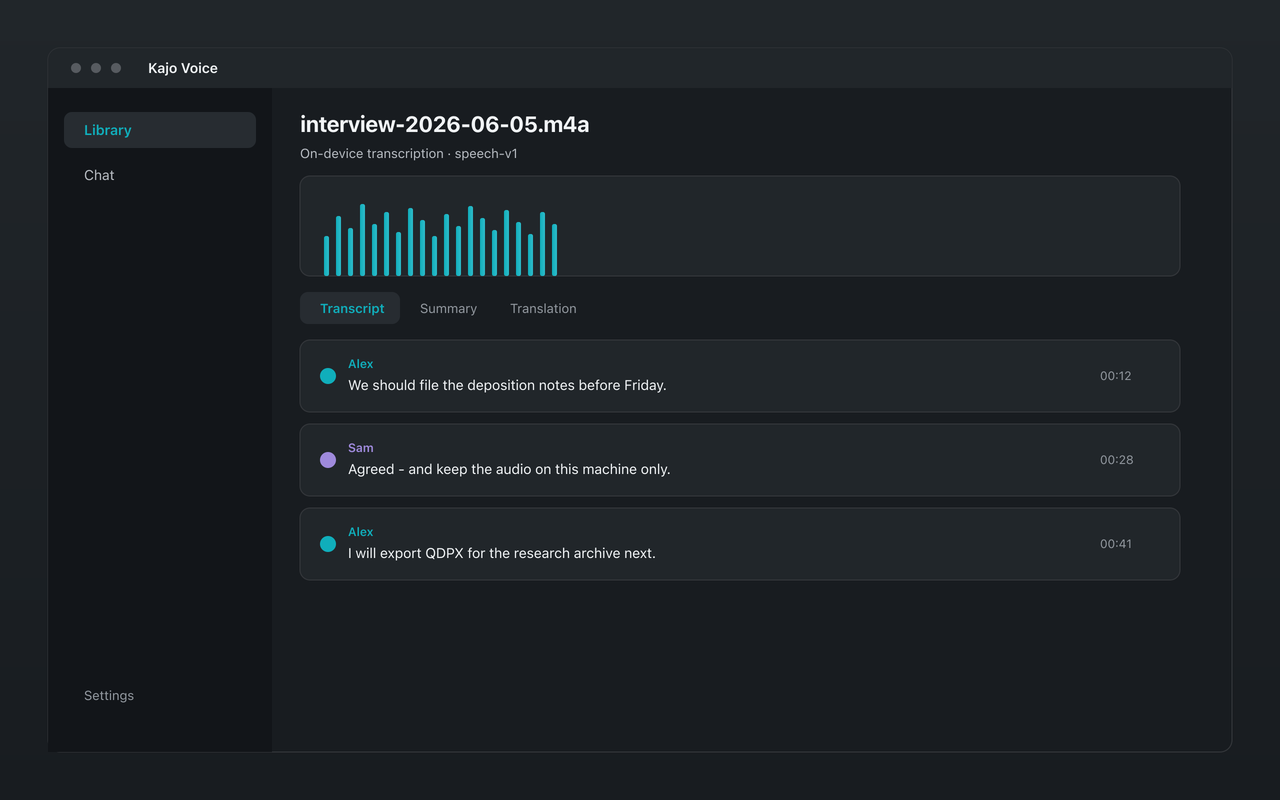
An Arabic interview does not stop at the transcript. Kajo labels the speakers automatically per recording (rename them once), translates the transcript on-device into 59 target languages while keeping the Arabic original as the record, and lets you pin the folder and ask “What did the minister say about the contract?” in English — with the cited answer landing on the Arabic moment in the recording. Nothing in that loop leaves your machine.
Arabic transcription workflow in Kajo
Script and direction handling
Kajo handles Arabic text correctly: right-to-left rendering, proper Arabic Unicode encoding, connected script display. The transcript viewer shows Arabic in proper RTL layout. DOCX and TXT exports preserve Arabic script.
For users who work with Arabic content, the Kajo interface can be used in Arabic, and the marketing site has Arabic versions of key pages.
Reviewing proper nouns in Arabic content
Proper nouns are where Arabic transcription needs the most human review:
- Names: Arabic names as transcribed may not match preferred romanization or Arabic spelling conventions. Fix preferred spellings once with inline segment edit.
- Technical terms: Arabic technical vocabulary is often borrowed from English or French; correct the preferred Arabic renderings in the transcript after the first pass.
- Organizational names: Government agencies, companies, and organizations with specific Arabic names
- Dialect-specific terms: Domain-specific wording from your specific dialect or register
Inline segment edit keeps search, export, and cited chat aligned with your preferred spellings — corrections re-index chat without re-transcribing.
Bilingual subtitle export for Arabic content
Arabic recordings produced for multilingual audiences benefit from Kajo’s bilingual subtitle export. An Arabic-language interview can be exported with:
- an Arabic subtitle track (the original transcript)
- an English subtitle track (translated on-device)
This is useful for Arabic-language journalism, academic work, and documentary production aimed at international audiences.
Use cases for Arabic transcription
Journalism and media
Arabic-language journalists and media organizations need accurate transcription for:
- Interview transcripts
- Press conference transcripts
- Speech and official statement transcripts
- Documentary subtitles
MSA content from official sources transcribes reliably. Interview content usually needs a pass for names and organizations.
Academic research
Middle East studies, sociolinguistics, and anthropological research regularly involve Arabic audio. Kajo’s local processing is appropriate for research data under IRB protocols. Dialectal audio still benefits from a careful human pass on names and site-specific terms.
Legal and diplomatic
Gulf business contracts, legal proceedings in Arabic-speaking countries, and diplomatic communications often mix MSA with dialectal speech and English terminology. Review the language transitions when the stakes are high — and remember that Kajo is not a certified transcript.
Oral history and ethnography in diaspora communities
Oral historians and ethnographers recording Arabic-speaking families in France, the UK, Germany, the US, or Canada get tape that mixes Arabic with the local language. Multilingual transcription plus bilingual export keeps both languages in the record.
Limitations to be aware of
Kajo’s Arabic transcription performance, like all ASR systems, degrades with:
- Poor audio quality or significant background noise
- Heavy dialectal speech with no MSA register mixing
- Very fast speech rate
- Multiple simultaneous speakers in dense crosstalk
- Very rare names or specialized vocabulary that need a manual spelling pass
For critical Arabic transcription where accuracy is paramount (legal proceedings, diplomatic records), human review remains appropriate. Kajo is a tool for efficient first-pass transcription and searchable archiving, not a replacement for expert human review when accuracy is legally or diplomatically significant.